How It Works – Honeywell Battery Electrolyte Sensor
Introduction
As electric vehicles rapidly become the backbone of future transportation, battery safety has emerged as one of the most critical challenges facing OEMs and system designers. Lithium-ion batteries deliver exceptional energy density, but when failures occur, they can escalate quickly into thermal runaway events that threaten passenger safety, vehicle assets, and brand reputation. The Honeywell Battery Safety Electrolyte Sensor (BES) addresses this risk at its earliest and most preventable stage by detecting electrolyte vapor released during the first vent, minutes before thermal runaway begins. Unlike traditional ppm-based gas sensors that react too late, BES provides an early warning signal that enables the BMS to take corrective action, such as isolating the pack or stopping charge, before a catastrophic event occurs.
Principle of Operation
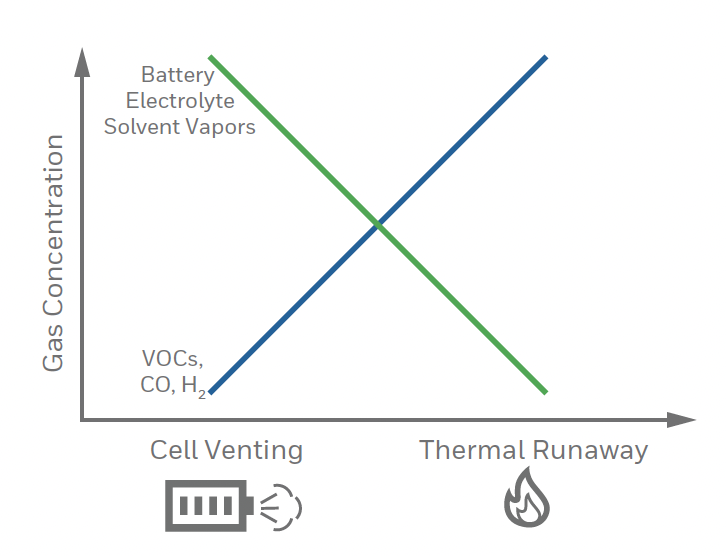
During a thermal runaway event, various gases are released. In the early stage, the cell vents a high concentration of electrolyte vapor. This includes gases such as Ethylene carbonate (EC), Diethyl carbonate (DEC), Ethyl Methyl carbonate (EMC) and Dimethyl carbonate (DMC) etc.
As the event progresses to an explosion, there is an increase in H2 and CO. The BES Series sensor is equipped with a siloxane-resistant metal oxide semiconductor sensor that is highly sensitive towards electrolyte vapors, H2 and CO. Due to its sensitivity to multiple target gases, the BES sensor ensures reliable and early detection compared to traditional gas sensors.
The BES sensor is equipped with a patented built-in rate of change algorithm, which triggers an alarm upon the detection of any of the target gases. This feature ensures quick and precise response to gas presence, enhancing safety and monitoring efficiency.
PPM based gas sensors may drift over a period increasing the risk of missing critical warning of thermal events. The BES rate of change algorithm approach addresses this concern as precise ppm monitoring is not required, ensuring early and reliable alerts.
Test Results
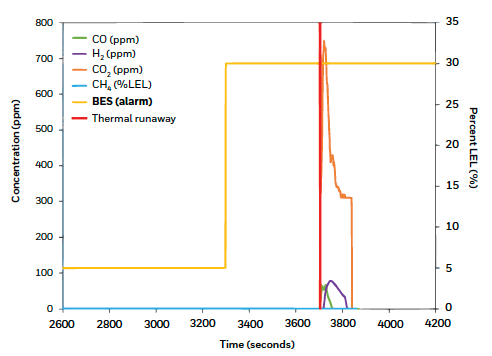
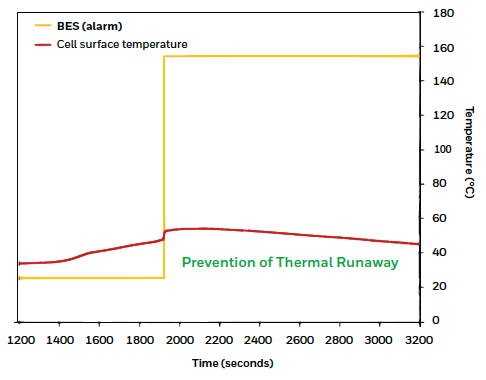
In this test, a pouch cell is overcharged at 2C to induce thermal runaway or explosion. Notice that the BES sensor alarms ~7 minutes before thermal runaway, giving the system ample time to stop overcharging.
In comparison, the traditional approach of monitoring H2, CO, CO2 and CH4 only showed a response during cell explosion/thermal runaway, typically too late to prevent significant battery damage.