
Robot Arm and Cobot Connectors
Interconnect for multi-axis industrial arms and collaborative robots — fieldbus networking, encoder and servo I/O, and vision links engineered to hold signal integrity through millions of repeated movements.
What Repetition Does to a Connector
The Same Move, Forever
An arm repeats one trajectory for years. Nothing about that is dramatic — it is simply relentless, and it finds every marginal contact and every under-specified latch eventually.
Cable Through the Axis
Every joint the harness crosses is a place it twists and bends. Flat flex earns its place here: it takes the movement in one plane instead of fighting it as a bundle.
Feedback Has to Be Exact
Encoder and force-sensor signals are what make the arm accurate. Lose integrity on those and you do not get a fault — you get parts that are quietly out of tolerance.
Serviced in Place
Arms are repaired on the line, not in a lab. Sealed parts that mate with standard connectors on standard footprints keep a repair to minutes rather than a rebuild.
Precision Is a Signal Integrity Problem
Robot arms are foundational in manufacturing, assembly and inspection, where precision, force control and repeatability decide whether the line runs. The motion is the visible part; what makes it accurate is a continuous stream of encoder counts, force readings and vision data moving cleanly between the arm and its controller.
That puts the interconnect in an unusual position. It is not carrying much power by the standards of a mobile robot — the cabinet handles that. It is carrying measurement, through a mechanism designed to move, in a cell surrounded by welders, drives and contactors. Degradation shows up as drift long before it shows up as a fault.
Amphenol’s answer is rugged interconnect that supports real-time communication, sensor feedback and motor control at production duty cycles, with sealed variants that drop into the footprints already on the machine.
Featured Products — Networking and Control
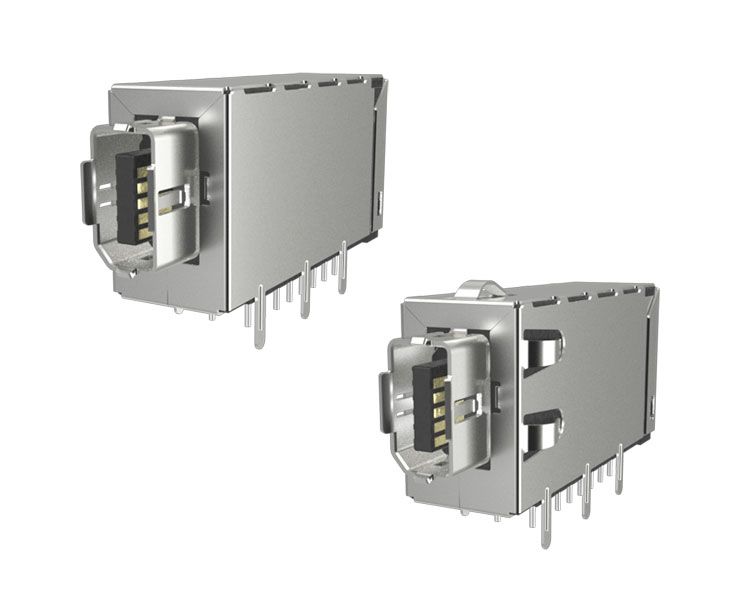
ix Industrial™ Magnetics
10G Ethernet with integrated magnetics and PoE++
A 10-position ix Industrial™ connector with the magnetics built in, which takes the discrete magnetics off the controller board and shortens the signal path. Cat6A performance with PoE++ to 90 W, and a two-point metal latch specified as more durable than an RJ45 tab.
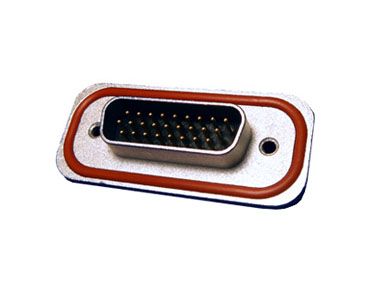
Rugged D-Sub
Sealed encoder and servo I/O in a standard footprint
The D-Sub is still where encoder and servo I/O lives on most arms. This is the same interface in a die-cast housing with silicone seals to IP67, so it drops into existing panel cut-outs and mates with the connectors already in the cabinet — a sealing upgrade without a redesign.
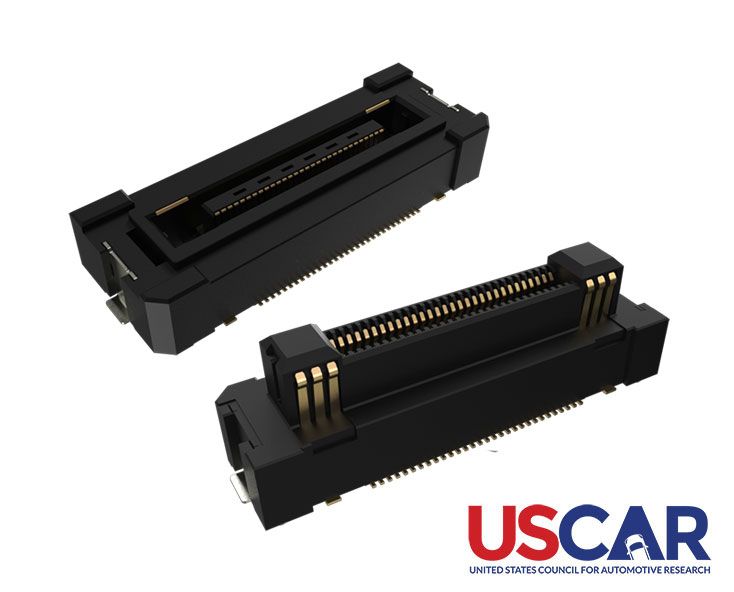
FloatCombo™ 0.50mm with Power Pin
Floating hybrid board-to-board inside the controller
Floating board-to-board for the controller stack, combining four independent power pins with high-speed signal in one connector. The float absorbs accumulated mechanical tolerance instead of transferring it into the contacts, which is what makes automated assembly repeatable.
Featured Products — Vision, Flex and Field Service
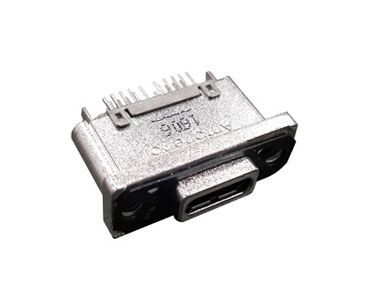
Rugged USB Type-C (MUSBR)
Sealed camera and teach-pendant interface
Generation 2 ruggedised USB Type-C in a die-cast housing sealed to IP67, for machine-vision cameras and pendant connections that live on the outside of the arm. Reversible, so there is no wrong orientation for an operator to find at the end of a shift.
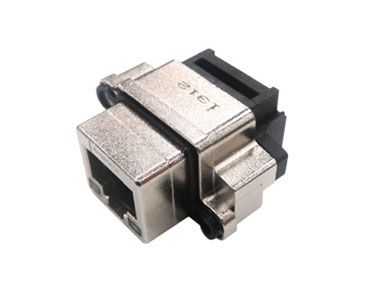
Rugged Modular Jack
IP67 Cat6A RJ45 for networked cameras and sensors
A sealed RJ45 for the parts of the cell where a standard jack would not last: die-cast housing, silicone seals to IP67, and the same interface every Ethernet/IP device on the floor already uses. Available in Cat6A, right-angle and vertical.
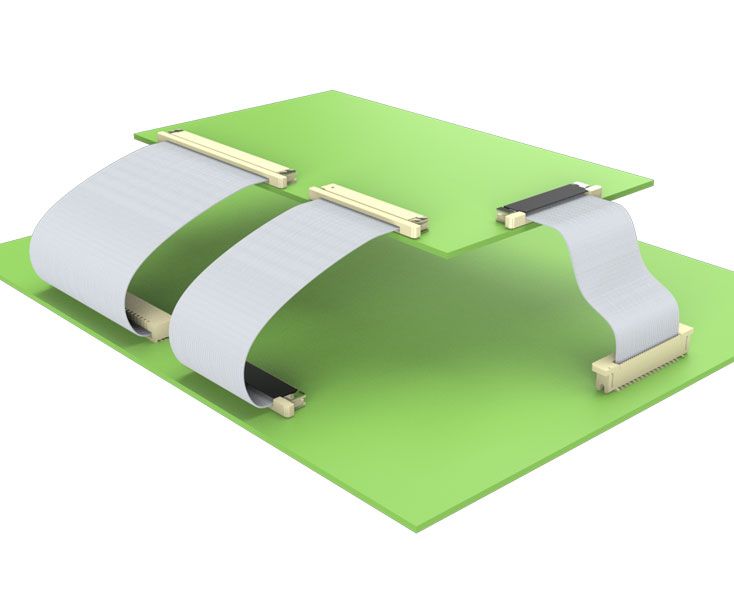
FFC Jumpers
Flat flex across the joint, board to board
Flat flexible cable jumpers for the board-to-board runs that cross a moving axis. A flat conductor takes bending in one plane rather than resisting it as a round bundle, and same-side or opposite-side contact layouts let the two boards mount whichever way the mechanics demand.
Choosing an Ethernet Interface
|
Feature |
ix Industrial™ Magnetics |
Rugged Modular Jack |
SPE IP20 |
|---|---|---|---|
|
Interface |
ix Industrial™ 10-position |
Standard RJ45 |
Single pair, IEC 63171-6 |
|
Speed |
Cat6A 10GBASE-T |
Cat6A |
1 Gb/s to 40 m |
|
Power |
PoE++ to 90 W |
Depends on the jack |
PoDL to 4 A |
|
Magnetics |
Integrated |
External |
Not applicable |
|
Sealing |
IP20 (IP6X on NDH) |
IP67 |
IP20 |
|
Durability |
5,000 mating cycles |
Standard RJ |
Metal thumb latch |
|
Best suited to |
Controller board, highest bandwidth |
Panel-mount cameras in a wet or dusty cell |
Sensors and actuators on one thin run |
Frequently Asked Questions
Specifying a Robot Arm?
Tell us which axis the cable has to cross, what the cell environment is like and how often it gets serviced. We will work back to a part, samples and full datasheets.