
How It Works – Amphenol Liquid Cooling Leakage Detection Sensor Cable
Introduction
As data centers scale to support artificial intelligence, cloud computing and high-performance workloads, thermal management grows more complex. GPUs, CPUs and optical modules keep rising in power density, and traditional air cooling using heat sinks and fans is reaching its limits. Liquid cooling answers that load by circulating coolant through cold plates that absorb heat from the components and carry it away to a radiator.
That efficiency comes with a new problem. Introducing liquid into an electronic environment means a small leak in the coolant path can cause an electrical short circuit or corrode critical components. In AI and HPC systems running 24/7, coolant leakage is not a maintenance inconvenience — it is a direct threat to uptime and data integrity. The Amphenol Liquid Cooling Leakage Detection Sensor Cable is a low-cost assembly that catches a leak before it reaches live electronics.
Principle of Operation
The sensor cable works by using the conductive properties of the cooling liquid itself. Two electrodes run the length of the cable, separated and held at a known resistance. When coolant escapes and contacts the cable, the fluid forms an electrical bridge between those electrodes. Resistance across the circuit drops, and the monitoring system reads that change as a leak event — triggering an alarm so the system can be shut down or contained before damage occurs.
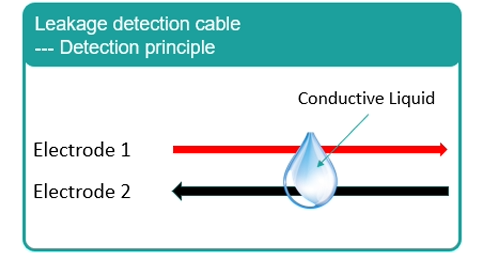
Because the mechanism is passive, there are no moving parts and no complex sensor electronics to calibrate or maintain. Only a small volume of liquid is needed to trigger the alarm, so even minor seepage is caught early rather than after it has pooled.
Where to Install It
Placement determines how early a leak is caught. There are two positions that matter:
- At pipeline junctions — fittings, quick disconnects and seals are where coolant paths are most likely to fail, so a sensor here catches a leak at source.
- At the chassis base — leaked fluid accumulates at the lowest point under gravity, so a sensor here acts as the catch-all for anything that escapes detection upstream.
Using both gives comprehensive coverage of the coolant loop. The cable has an outer diameter under 3 mm and flexible insulation, so it routes through narrow spaces and installs without tooling.
Key Specifications
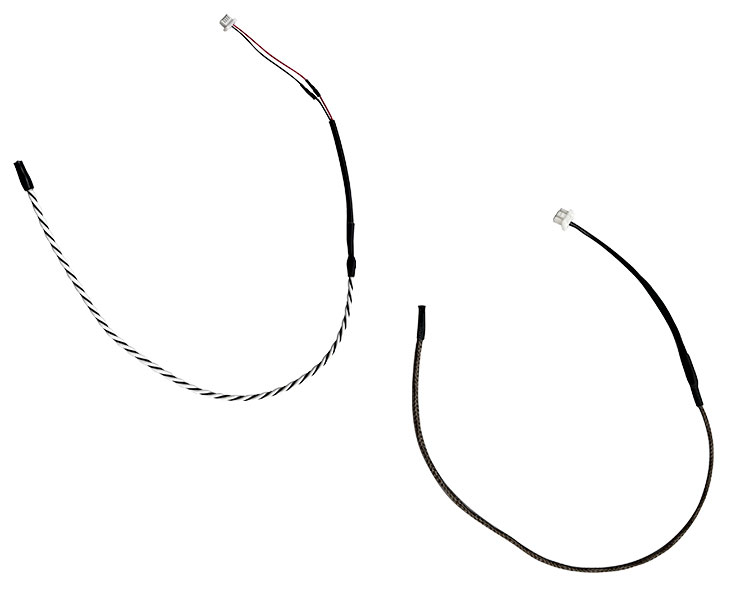
- Part numbers: 10183153-001LF (Type A), 10180993-001LF (Type B)
- Cable OD: less than 3 mm
- Detection: passive resistance change, no moving parts
- Reusable: can be dried and returned to service after an event
- Customisation: lengths and terminations built to the chassis layout
Because the assembly is reusable rather than single-use, the cost of ownership stays low relative to detection methods that must be replaced after every trigger.
Integrate Leak Detection with Confidence
Leak detection is the safeguard that makes an aggressive liquid cooling design defensible. If you are specifying a direct-to-chip loop, cold plate manifolds or quick disconnects, our engineering team can advise on sensor placement and build the assembly to your lengths and terminations.
See the full range on our Liquid Cooling Solutions for AI Data Centers page, or contact us to discuss a customised assembly.